Hanuman and the Sanjeevani Mountain
The night Lakshman fell on the battlefield of Lanka, and Hanuman flew to the Himalayas and returned before sunrise with a whole mountain.
The Story in Brief
Lakshman is wounded, and only Hanuman can reach the cure in time.
Where
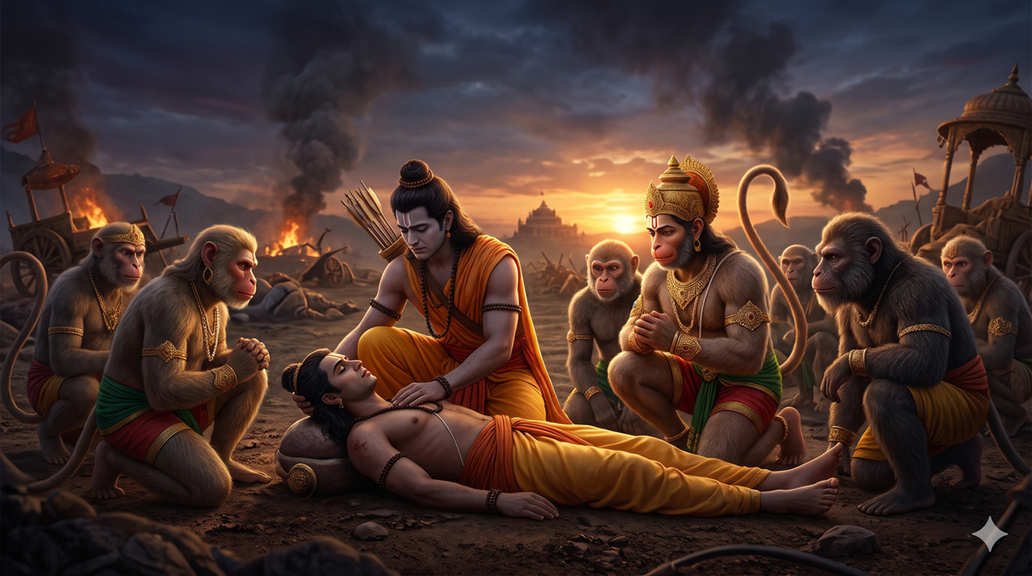
Lanka, the war between Shri Ram and Ravana, told in the Yuddha Kanda.
Who needed healing
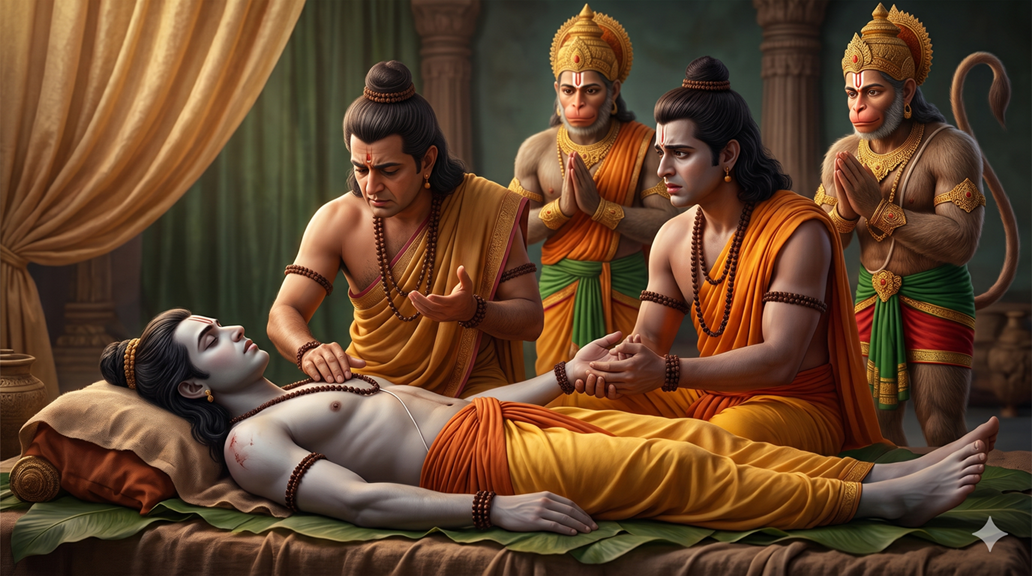
Lakshman, struck down by Ravana’s Shakti weapon in battle.
The cure
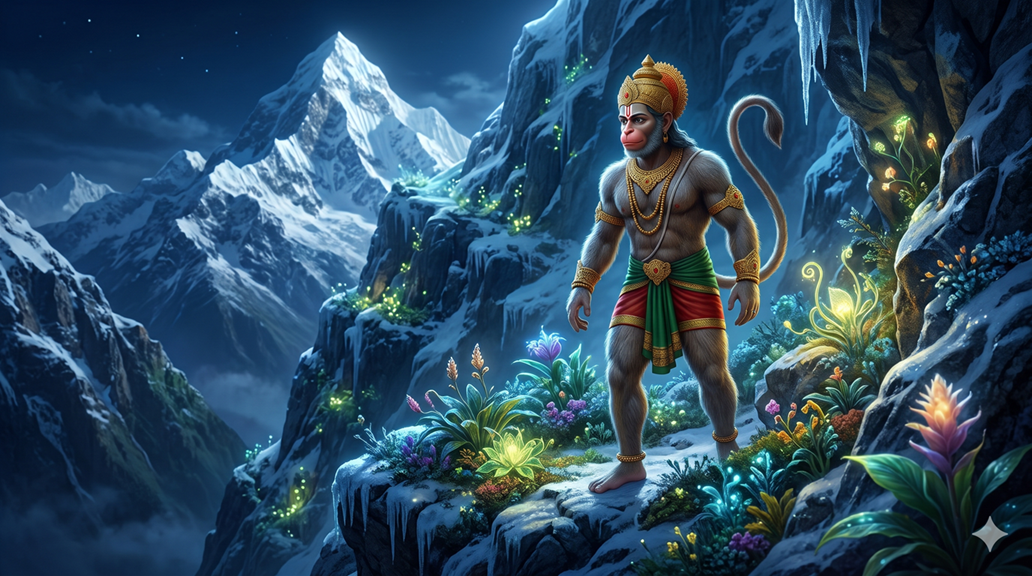
Herbs from Dronagiri (Dhronagiri) in the Himalayas, to be used before sunrise.
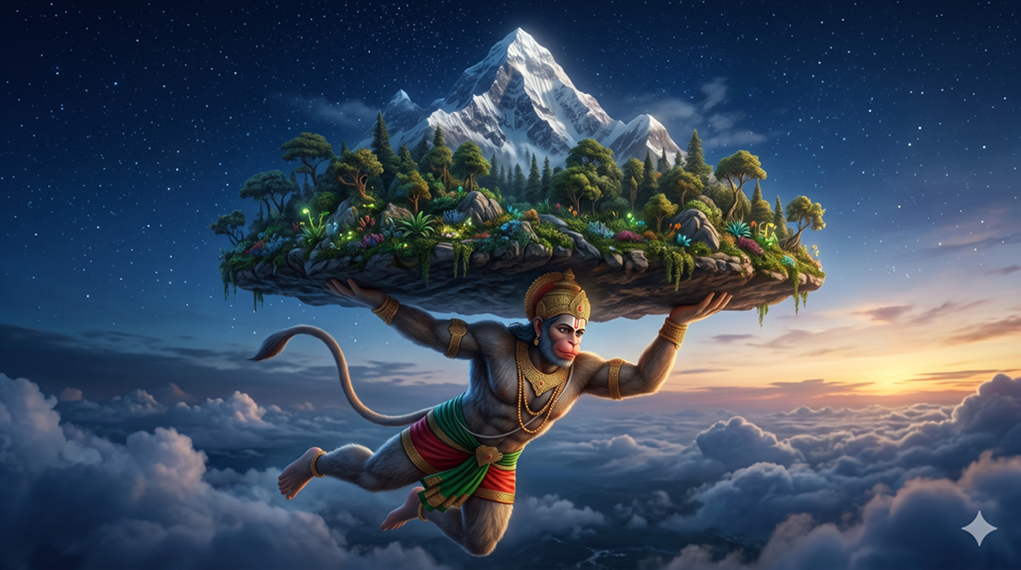
Hanuman’s feat
He carried the entire mountain through the night and brought it to the battlefield.
The Full Story
From the battlefield to the Himalayas and back.
Lakshman falls
In the great battle, Ravana hurled his Shakti, a divine spear, and it struck Lakshman. He lay still on the field. Shri Ram, seeing his brother fallen, was overcome with grief, and the whole vanara army was shaken.
Jambavan’s counsel
The wise Jambavan said only one physician could help: Sushena, the vaidya of Lanka. Hanuman flew into the city, lifted Sushena’s entire house with him, and set it down in Ram’s camp.
The four herbs and the deadline
Sushena examined Lakshman and named herbs that grow on a mountain far away in the Himalayas. They had to be brought before sunrise. The task was nearly impossible, and the army looked to Hanuman.
The flight north
Hanuman bowed to Shri Ram and set out. With the strength of the wind, his father, he crossed the sky in a single night, over rivers, forests and cities.
Kalanemi’s trick
Ravana learned of the plan and sent the demon Kalanemi to delay Hanuman. Disguised as a sage, Kalanemi invited him to rest and drink from a lake. In popular tellings, a crocodile in the water was a cursed apsara who warned Hanuman, and Hanuman defeated Kalanemi and went on his way.
The mountain
At Dronagiri, Hanuman found the slopes glowing with countless herbs. He could not tell which four were the right ones, and there was no time to ask. So he did what only he could do: he lifted the whole mountain, and carried it back.
Bharat’s arrow
In one popular version, passing over Ayodhya in the dark, Hanuman was mistaken for a demon by Bharat, who shot an arrow. Hanuman fell, saying “Shri Ram” as he did. Bharat, shocked, tended to him, and learned what was happening. Overjoyed to hear of his brothers, he sent Hanuman on with love.
Before sunrise
Hanuman reached Lanka before dawn. Sushena found the right herbs, and Lakshman rose, whole and well. Ram embraced Hanuman, and the vanaras cheered. Hanuman later returned the mountain to its place.
The Valmiki Ramayana, Tulsidas’s Ramcharitmanas and regional Ramayanas tell the story with different details. The Kalanemi and Bharat episodes in particular come from later tellings. This page follows the widely told version.
The Four Herbs of Sanjeevani
Sushena named four herbs, each with its own power.
Mrita Sanjeevani
Restores life to the one who has fallen.
Vishalyakarani
Removes weapons and wounds from the body.
Sandhanakarani
Joins what has been broken or cut.
Suvarnakarani
Brings back healthy skin and color.
Which plants these are is not known with certainty. Botanists and ayurveda scholars have proposed several candidates over the years, and the question remains open.
In the Hanuman Chalisa
Tulsidas honors this moment in a single line.
श्रीरघुबीर हरषि उर लाये॥Laay sanjeevan Lakhan jiyaaye, Shri Raghubeer harashi ur laaye.
Meaning: Hanuman brought the Sanjeevani herb and revived Lakshman. Shri Raghuvir, overjoyed, embraced him to his heart.
Devotees recite this chaupai in times of illness, and for the recovery of loved ones. For the full text and verse-by-verse meaning, see our Hanuman Chalisa with meaning pages.
Where Is the Sanjeevani Mountain Today?
Two places claim a part of the story.
- Dronagiri, Uttarakhand. A mountain village in the Chamoli district is named for the mountain. Locals say that, remembering how Hanuman took their sacred mountain, they do not worship him there.
- Sri Lanka. According to local tradition, pieces of the mountain fell along the island’s coast. Places such as Ritigala, Rumassala (near Galle) and Unawatuna are associated with these stories, and many plants there are used in traditional medicine.
These are traditions held by the local people. They are shared here as stories and not as proven facts.
What the Story Teaches
- Service without delay. Hanuman set out the moment he was asked, with no questions and no bargaining.
- Devotion over doubt. When he could not identify the herbs, he did not turn back. He took the whole mountain.
- Humility with strength. After this feat, he asked for nothing. Hanuman returned the mountain, and he stayed Ram’s servant.
- Staying focused. Kalanemi’s trap, and the mistaken arrow of Bharat, did not stop him from his purpose.
Common Questions
Short answers about the Sanjeevani story.
Why did Hanuman bring the whole mountain?
Sushena had named four herbs, but when Hanuman reached Dronagiri, he could not tell which ones they were among the many glowing plants. With sunrise approaching, he lifted the entire mountain so the physician could choose the right herbs.
Which mountain is the Sanjeevani mountain?
It is called Dronagiri (Dhronagiri) and is said to be in the Himalayas. A village of that name exists in Chamoli district, Uttarakhand, and is traditionally linked with the story.
Who was Sushena in the Ramayana?
Sushena was the royal physician of Lanka. Hanuman brought him, along with his house, to the battlefield, where he diagnosed Lakshman and named the herbs needed.
Which Hanuman Chalisa verse mentions Sanjeevani?
The chaupai “Laay sanjeevan Lakhan jiyaaye, Shri Raghubeer harashi ur laaye” describes Hanuman reviving Lakshman and Ram embracing him in joy.
Did Hanuman return the mountain?
According to popular tradition, yes. After the herbs were used, Hanuman carried the mountain back and set it in its place.