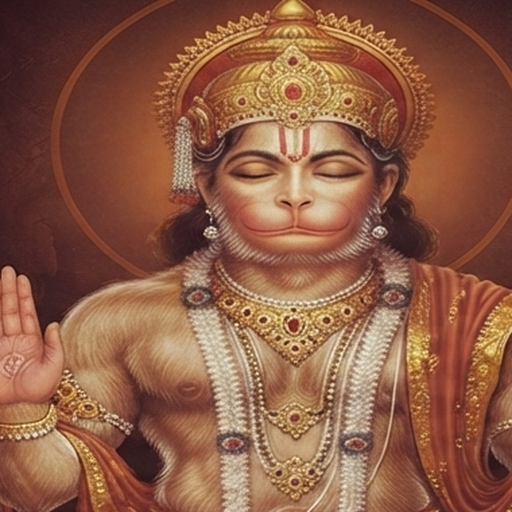
Hanuman on Arjuna's Chariot Flag
How Hanuman came to ride the banner of Arjuna's chariot at Kurukshetra, from his meeting with Bhima in the forest to the chariot that burned when he left.
The Story in Brief
Two sons of the wind, and a banner that protected a war.
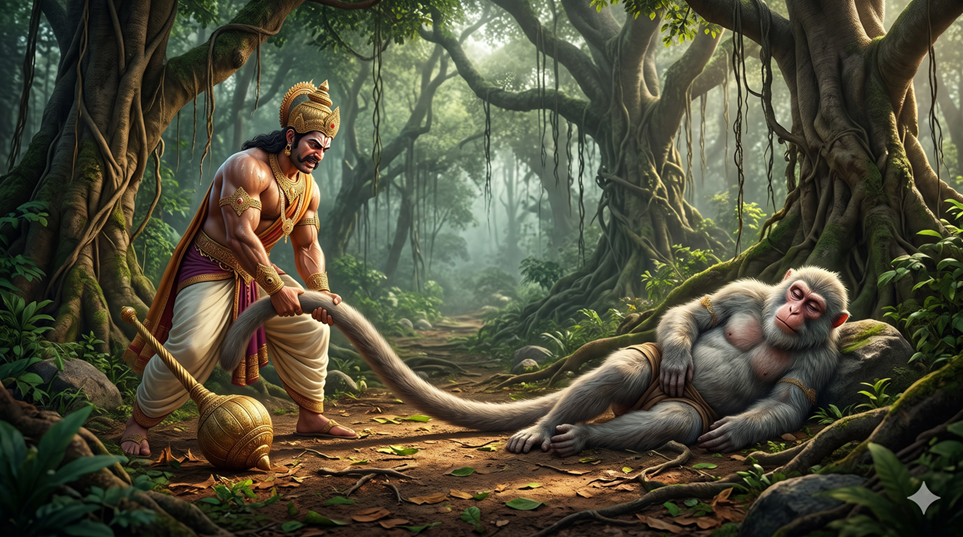
Meeting Bhima
In the forest, an old monkey's tail blocks Bhima's path.
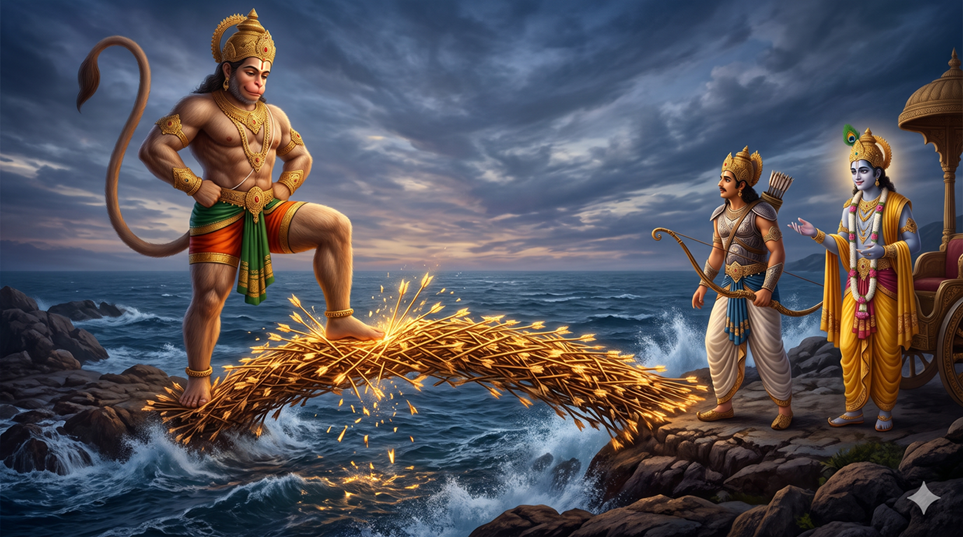
The bridge of arrows
Arjuna builds a bridge of arrows, and Hanuman puts it to the test.
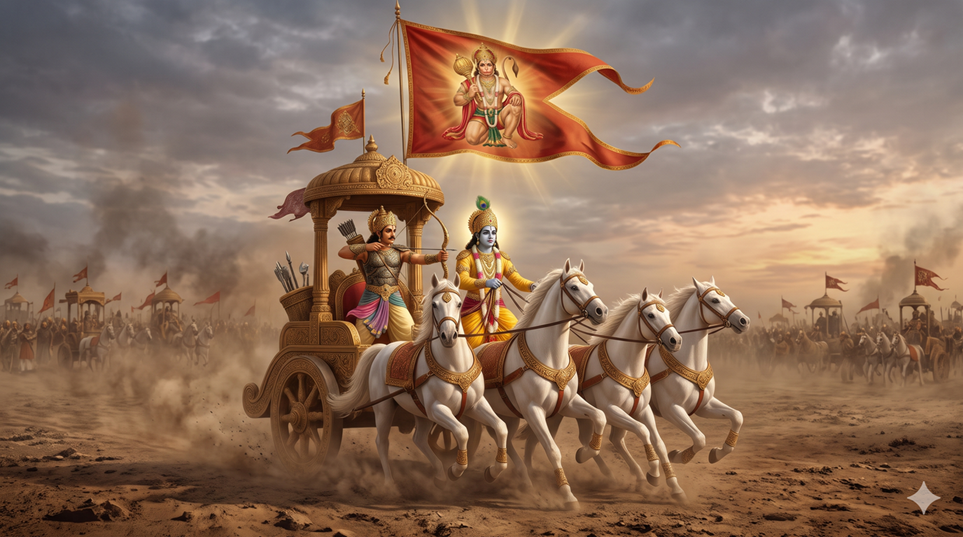
The flag at Kurukshetra
Hanuman rides the banner of Arjuna's chariot, with Krishna as charioteer.
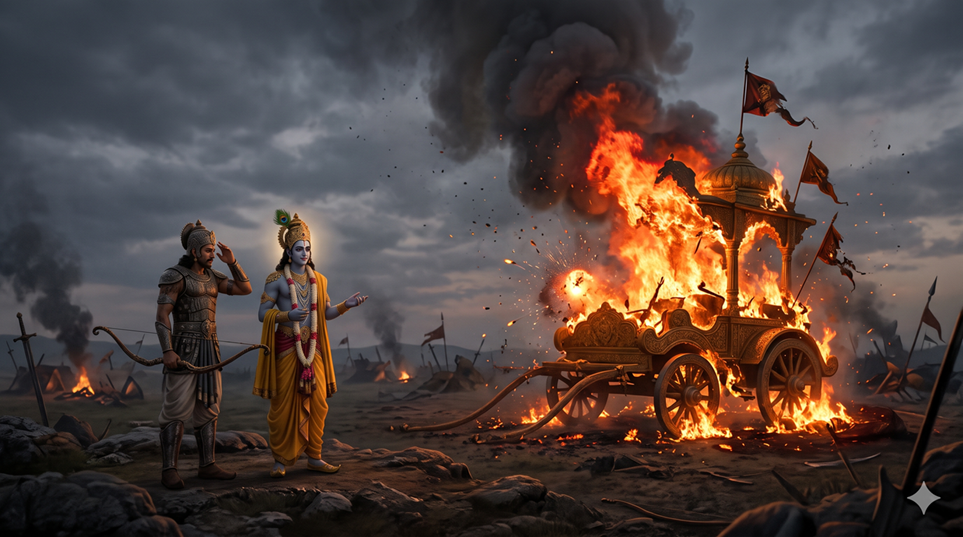
The chariot burns
When Krishna and Hanuman leave, the chariot bursts into flames.
Hanuman Meets Bhima
The source in the Mahabharata (Vana Parva).
Bhima goes for the flower
During the Pandavas' exile in the forest, Draupadi asked Bhima to fetch a rare Saugandhika flower. Bhima set off in search of it, roaring and uprooting trees along the way.
The old monkey
On a narrow path through a banana grove, Bhima found an old monkey lying with his tail across the way. Bhima asked him to move aside. The monkey, who seemed too weak to rise, asked Bhima to move the tail himself.
The tail will not move
Bhima, the strongest man alive, pulled at it with one hand and then with both, and could not lift it even slightly. Humbled, he folded his hands and asked who the monkey really was.
Hanuman reveals himself
The monkey was Hanuman, Bhima's elder brother in spirit, since both were sons of Vayu, the wind god. Hanuman embraced him and showed the vast form in which he had crossed the ocean.
The boon
Hanuman blessed Bhima and promised: 'I will be present on the banner of your brother Arjuna, and my roar will add to your battle cry and frighten your enemies.'
Arjuna and the Bridge of Arrows
A folk tale told across India.
Arjuna's boast
In a folk tale, Arjuna visited Rameshwaram, where Ram built the bridge to Lanka. He remarked that Ram could have built it with arrows and not stones. A monkey sitting nearby said it would not bear his weight.
The test
Arjuna accepted the challenge: if Hanuman broke the bridge of arrows, Arjuna would give up his life. Hanuman stepped on the bridge, and it shattered. Arjuna built it again, and it broke again.
Krishna's grace
Arjuna was about to end his life, when Krishna appeared and asked him to build the bridge once more, this time after Krishna blessed it. Hanuman stepped on it with all his weight, and it held.
A vow
Hanuman saw that Krishna and Ram were one. He bowed, and promised to protect Arjuna by staying on his banner for the war.
The Bhima meeting is told in the Mahabharata. The arrow bridge is a popular folk and later tradition, and its details change from region to region.
The Flag at Kurukshetra
Protection on the battlefield.
The ape banner
From then on, Arjuna's chariot flew a flag with Hanuman's image, and Arjuna was called Kapidhwaja, 'the one with the monkey banner'. The Bhagavad Gita opens its battle scene with Arjuna described in that way.
Hanuman's roar
At Kurukshetra, Hanuman's presence on the flag was said to strengthen Arjuna's chariot against even the most powerful divine weapons, and his roar shook the enemy.
The chariot burns
On the last day of the war, Krishna asked Arjuna to step down first. Then Krishna got down, and Hanuman left the flag. The chariot burst into flames at once. Krishna explained that divine weapons of Karna, Drona and Bhishma had been held back by his grace and by Hanuman's presence.
In the Hanuman Chalisa
Tulsidas on the power of Hanuman's roar.
तीनों लोक हाँक तें काँपै॥Aapan tej samhaaro aapai, teenon lok haank te kaanpai.
Meaning: You alone can hold your own radiance. The three worlds tremble at your roar.
For the full text and verse-by-verse meaning, see our Hanuman Chalisa with meaning pages.
What the Story Teaches
- Humility in strength. Bhima, the strongest man alive, learned that real strength bows before devotion.
- Pride is tested. Arjuna's boast was answered, and he found that Krishna's grace was behind his victories.
- Protection by presence. Hanuman guarded the chariot simply by being there, and the chariot fell when he left.
- Brothers in spirit. Hanuman and Bhima, both sons of Vayu, show that devotion and strength can go together.
Common Questions
Short answers about Hanuman and the Kapidhwaja flag.
Why was Hanuman on Arjuna's chariot flag?
In the Mahabharata, Hanuman promised Bhima that he would be present on Arjuna's banner and add his roar to Pandava battle cries. Folk tales add that he made a vow after the test of the arrow bridge.
Who is Kapidhwaja?
Kapidhwaja means 'one with the monkey banner'. It is a name of Arjuna, whose chariot flag carried the image of Hanuman.
Did Hanuman fight in the Mahabharata war?
He did not fight with weapons. He stayed on Arjuna's flag as a protector, and his roar was said to weaken the enemy.
Why did Arjuna's chariot burn after the war?
After the war, Krishna and Hanuman left, and the weapons that had been held back by their presence burned the chariot. Krishna told Arjuna that the chariot had been protected only by divine grace.
Where is Hanuman mentioned in the Bhagavad Gita?
Chapter 1 of the Gita calls Arjuna Kapidhwaja, the one with the monkey banner, as he surveys the armies at Kurukshetra.